 QiblaTrue
Qibla Direction: Find It From True North
Find the qibla as a bearing from true north, and see why a phone compass can disagree. City examples for New York, Los Angeles, Chicago and London.
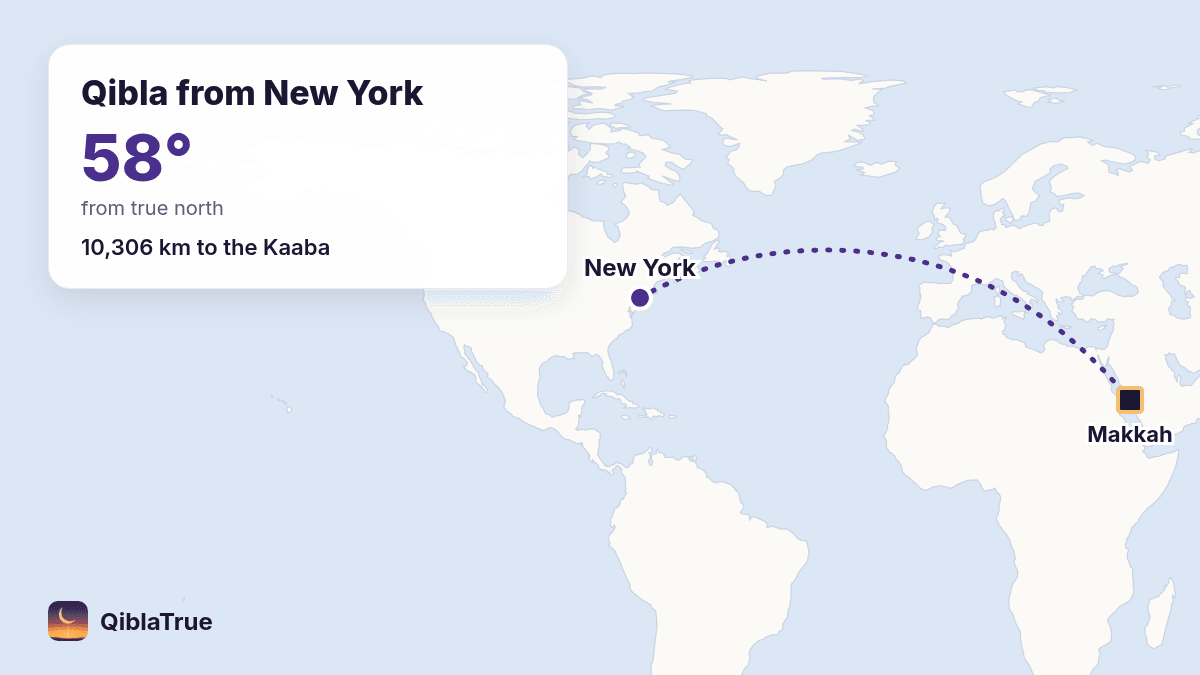
Wherever you pray, you face the Kaaba in Makkah. Turning that into something you can act on in a living room in New York or a hotel in London means using a number: your qibla direction, written as a bearing in degrees from true north. This guide explains what that number means, how to read it, and why the compass on your phone can sometimes show a different figure even when nothing is wrong.
What qibla direction means
The qibla is the direction of the Kaaba from where you are standing. On a globe, the shortest route between two points is a great circle, the same kind of path long-haul flights follow. The qibla bearing is the initial direction of that great-circle path from your location to the Kaaba, measured clockwise from true north and given in degrees. City pages also add a compass point, such as ENE (east-north-east) or NNE (north-north-east), so you get a quick sense of the direction before you look at the exact figure.
It helps to set aside the flat world map for a moment. A straight line drawn across a flat map is not the shortest path on a round Earth. That is why the answer can look surprising. On a typical wall map, Makkah appears to be south-east of the United States, yet the great-circle path from North America sets off towards the north-east and curves over the North Atlantic.
For the calculation, QiblaTrue uses the Kaaba's coordinates in the rounded form 21.4225°N, 39.8262°E. The distance shown on a city page comes from a separate haversine calculation. It tells you how far away the Kaaba is, but it plays no part in working out the bearing.
How to read a bearing in degrees
A bearing is simply an angle measured clockwise from true north:
- 0° is true north
- 90° is east
- 180° is south
- 270° is west
Everything in between fills in the circle. A bearing of 45° sits exactly halfway between north and east, which is north-east. City pages pair the number with a compass point so you can check your reading at a glance.
Take New York. Its qibla is 58.5° ENE. Start by facing true north, then turn clockwise (to your right) through 58.5°. That leaves you a little past north-east, leaning towards east, which is what ENE describes.
Now London. Its qibla is 119.0° ESE. Facing true north, turn clockwise past due east (90°) by roughly another 29°. You end up facing east-south-east. From Britain the Kaaba lies to the south-east, and the bearing reflects that.
The number is the direction you face at the very start of the path. You do not need to picture the whole curved route across the globe. Face the bearing, and you are facing along the great circle that leads to the Kaaba.
True north versus a phone's magnetic compass
True north is the direction towards the geographic North Pole, the point the Earth spins around. A magnetic compass points somewhere else: towards magnetic north, which follows the Earth's magnetic field. The angle between the two is called magnetic declination. It varies from place to place and slowly changes over time, which is why NOAA publishes the World Magnetic Model and a declination calculator.
Many phone compasses show magnetic north by default. QiblaTrue reports the qibla as a bearing from true north and corrects for this difference. So if you compare the app or a city page with a raw magnetic reading, the two numbers can disagree even when both are working correctly.
The size of the gap depends on where you are. As approximate illustrations, as of late 2026:
- New York: declination is about 12.5° W, so the 58.5° true bearing reads at roughly 71° on a raw magnetic compass.
- Los Angeles: declination is about 11.3° E, so the 23.9° true bearing reads at roughly 13° magnetic.
- London: declination is about 1.2° E, so the 119.0° true bearing reads at roughly 118° magnetic, a very small difference.
In parts of the United States, then, the gap is large enough to matter, while in London it is barely noticeable.
Phone compasses can also be pulled off course by nearby metal and electronics. If the reading seems unsteady, the QiblaTrue Qibla info screen suggests: "Hold the phone flat and away from magnets, speakers and metal. Calibrate when the accuracy badge is poor. True north is used when location is available." The app's calibration tips are short:
- Hold the phone flat.
- Move away from metal, magnets and laptops.
- Remove magnetic cases.
- Wave the phone in a figure-8.
A later guide on finding the qibla while travelling will cover hotel rooms, metal interference and full calibration in more depth.
Worked examples from live city pages
The figures below come from QiblaTrue's live city pages. Each page shows the bearing from true north, a compass point and the distance to the Kaaba.
United States
- New York: 58.5° ENE, 6,404 miles
- Los Angeles: 23.9° NNE, 8,341 miles
- Chicago: 48.7° NE, 6,926 miles
- Houston: 45.5° NE, 7,813 miles
A clear pattern stands out. From the United States the great-circle qibla points north-east, not south-east. The further west you go, the more northerly it becomes. Los Angeles, at 23.9°, is almost exactly north-north-east. Chicago and Houston both sit close to north-east, and New York leans a little further towards east.
The share image for this article shows New York's figures in a slightly different form. The map rounds the bearing to the nearest degree, 58°, and gives the distance in kilometres, 10,306 km. That is the same distance as the 6,404 miles on the city page, just in a different unit.
United Kingdom
- London: 119.0° ESE, 4,794 km
- Manchester: 118.5° ESE
- Glasgow: 118.3° ESE
Across Great Britain the bearing barely changes. London, Manchester and Glasgow all fall within about one degree of each other, each pointing east-south-east.
These are city-level bearings for each city as a whole, not for individual mosques.
How QiblaTrue shows the bearing
The QiblaTrue app and the city pages both show the qibla as a bearing in degrees from true north, alongside a compass. On a city page you read the number and compass point and turn to face it. In the app, the bearing is shown with a compass, and true north is used when location is available. The app works offline, so it still works when you have no signal.
If you also need prayer times for that city, the same city page shows today's times. Times can differ from your local mosque's timetable because of the calculation method and other settings, and our guide on why prayer times differ explains how to match them. In the app you can choose from 14 calculation methods, pick Hanafi or Standard Asr, and adjust individual times by up to ±30 minutes.
Some people prefer to check the qibla against their mosque or an existing prayer space. Practice around small deviations is a matter on which scholars differ, so if you have a question about it, ask a local imam or a scholar you trust.
FAQ
Is the qibla from the US south-east?
No. It is north-east, because the shortest path over the globe is a great circle, not the straight line on a flat map. From Los Angeles it is almost north-north-east, at 23.9°.
Why does my compass show a different number?
Most often because your phone is showing magnetic north while the bearing is measured from true north. The gap is magnetic declination, and in some US cities it is more than 10°. Metal, magnets and electronics nearby can also disturb the reading. A later travelling guide will cover this in more detail.
Do I need the internet?
Not for the app, which works offline. The city pages on the website need a connection to load.
QiblaTrue is a free download for iPhone. It shows the qibla as a bearing from true north, works offline, and can be aligned to a mosque timetable with method, Asr and ±30-minute adjustments. Get QiblaTrue on the App Store.